

9600mAh 20W USB-C PD Power Bank for iPhone & iPad
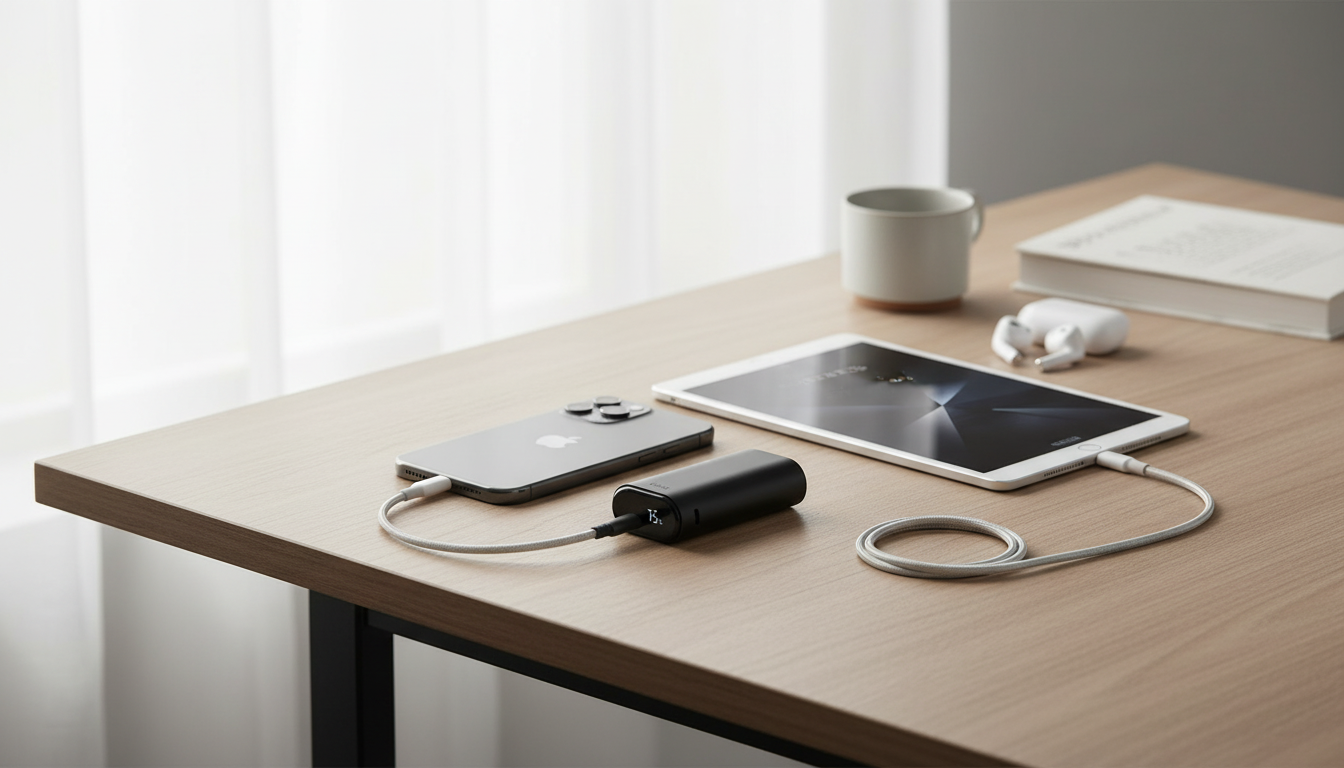
Portable Charger 9600mAh 20W PD Power Bank with USB-C for Apple Devices
A compact 9600mAh power bank with 20W Power Delivery (PD) and USB-C can keep an iPhone or iPad topped up quickly without adding much bulk. The key is understanding what 9600mAh typically translates to in real use, how 20W PD changes charging speed, and which details matter most when pairing a battery pack with Apple gear.
What This Power Bank Is Built For
- Pocket-friendly backup power for iPhone-focused daily carry, commuting, and short trips where an outlet isn’t guaranteed.
- 20W USB-C Power Delivery support aimed at faster charging on compatible iPhone and iPad models.
- Mid-capacity balance designed to blend practical runtime with reasonable recharge time and easy portability.
Real-World Capacity: What 9600mAh Typically Delivers
Power banks advertise capacity in milliamp-hours (mAh), but that number is measured at the battery’s internal voltage (commonly around 3.7V). Phones and tablets charge at higher voltages (like 5V, 9V, or more), so the power bank must boost voltage and regulate output—both of which introduce efficiency losses. The result is that usable energy is always lower than the headline number.
- Expect fewer full recharges than “9600mAh” suggests once conversion losses are factored in.
- Real-world results vary based on cable quality, device temperature, and whether the phone is being used heavily while charging (navigation, camera, hotspot, etc.).
- Best for extending a day rather than replacing a wall charger for multiple days of heavy use.
Practically, a 9600mAh class pack is a sweet spot for people who want meaningful top-ups without carrying a larger brick. It’s often enough to rescue a low battery before dinner, refresh a phone during a commute, or keep a second small device alive.
20W Power Delivery: Why It Matters for iPhone and iPad
USB Power Delivery (PD) is a charging standard that lets the charger and device negotiate safe voltage/current profiles. For Apple devices that support fast charging, PD can deliver noticeably faster charging than a basic 5W output—especially when the battery is low.
- Faster where it counts: speed gains are most noticeable at lower battery percentages.
- Normal tapering: iPhones and iPads typically slow charging as the battery fills to protect long-term battery health.
- Cable matters: PD benefits depend on the right cable and a compatible device.
For Apple’s official guidance on iPhone fast charging, see Apple Support: Fast charge iPhone. For deeper background on how PD works across devices, the USB-IF overview of USB Power Delivery is a useful reference.
USB-C Port Advantages for Apple Setups
- Wider cable compatibility: use USB-C to Lightning for Lightning iPhones, and USB-C to USB-C for USB-C iPads and many accessories.
- Often faster power bank recharging: many USB-C power banks can recharge more quickly than older USB-A-only models, depending on their USB-C input rating.
- Simpler packing: fewer cable types to manage when traveling with mixed Apple devices and USB-C accessories.
With Apple shifting more of its lineup to USB-C, a USB-C-based power bank tends to fit better into modern everyday carry—especially if you’re charging an iPad, a newer iPhone, or USB-C accessories alongside a Lightning iPhone.
Everyday Scenarios Where It Helps Most
- Long days away from outlets: navigation, photos, ride-share apps, messaging, and streaming can drain a phone faster than expected.
- Emergency top-ups: a quick boost before boarding a flight, heading into class, or walking into back-to-back meetings.
- Two-device coverage: keeping an AirPods case, a spare phone, or a secondary device running when outlets are limited.
A mid-capacity PD power bank shines when the goal is convenience and flexibility: enough power to stay comfortable, without the weight and recharge time of a much larger battery.
At-a-Glance Specs and What They Mean
| Spec | What to look for | Why it matters for Apple devices |
|---|---|---|
| Battery capacity | Around 9600mAh | Enough for meaningful top-ups without a bulky brick |
| Fast charging | USB Power Delivery up to ~20W | Enables faster iPhone/iPad charging than basic 5V output |
| Port type | USB-C (plus any extra ports if included) | Works with USB-C to Lightning and USB-C to USB-C cables |
| Cable requirement | USB-C to Lightning (iPhone) or USB-C to USB-C (USB-C iPad) | Fast charging depends on the correct cable and device support |
| Travel handling | Carry-on friendly; keep terminals protected | Most airlines allow power banks in carry-on, not checked baggage |
Safety and Battery Care Tips
For air travel, power banks are typically allowed in carry-on bags and generally not permitted in checked luggage. Always follow the latest airline and screening rules; the TSA guidance on spare lithium batteries and power banks is a practical starting point.
How to Choose the Right Portable Charger for Apple Devices
FAQ
Will a 20W PD power bank fast-charge an iPhone?
Yes—compatible iPhone models can fast-charge from a 20W USB-C PD power bank when you use the correct cable (USB-C to Lightning for Lightning iPhones, or USB-C to USB-C for USB-C models). Charging speed is fastest at lower battery levels and typically slows as the battery percentage rises.
How many times can a 9600mAh power bank charge an iPhone?
It’s usually fewer full charges than the rated 9600mAh implies because energy is lost during voltage conversion and normal charging inefficiency. The exact number depends on the iPhone model, battery size/health, cable quality, and whether the phone is being used while charging.
Can a power bank go on an airplane?
In most cases, yes—power banks are generally allowed in carry-on luggage but not in checked bags. Follow airline/TSA rules and protect the terminals from short-circuiting during travel.











Leave a comment