

Brave Beginnings: Build Courage to Try New Things
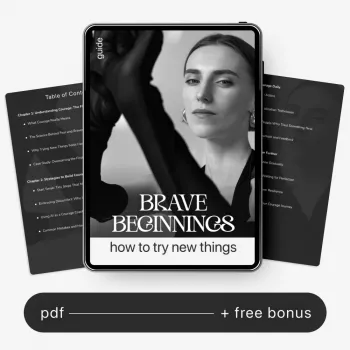
Brave Beginnings: A Practical Way to Build Courage for Trying New Things
Trying something new can trigger worry, self-doubt, or perfectionism—even when the goal is exciting. A steadier approach is to treat courage like a skill: start small, practice often, and use simple tools to recover quickly when things feel uncomfortable. The steps below focus on repeatable habits that make new experiences feel safer and more doable over time.
What “courage” looks like in everyday life
Courage usually isn’t a dramatic leap. Most of the time, it’s a small decision made while discomfort is still present.
- Courage is action with discomfort present, not the absence of fear or nerves.
- Small acts count: introducing yourself, joining a class, sharing an idea, or learning a new skill for 10 minutes.
- Confidence often follows action; waiting to “feel ready” can keep goals stalled.
- Progress signals to look for: starting sooner, recovering faster, and needing less reassurance.
Stress responses can make new situations feel bigger than they are—your body may treat “new” like “unsafe.” For a clear overview of how stress shows up physically, see the American Psychological Association (APA) guide on stress effects on the body.
Common blocks that make new things feel harder than they are
- Perfectionism: turning a first attempt into a final exam instead of practice.
- Catastrophic thinking: assuming one awkward moment means lasting embarrassment or failure.
- Identity pressure: “If I’m not naturally good at this, it’s not for me.”
- Over-comparison: using other people’s highlight reels to judge a beginner stage.
- All-or-nothing planning: believing it only counts if it’s a big leap rather than a series of small tries.
Quick reframes that unlock action
| Stuck thought | Swap-in thought | Next tiny step |
|---|---|---|
| “I’ll look stupid.” | “It’s normal to look new at something.” | Practice for 5 minutes privately, then repeat once in public. |
| “If I’m not good immediately, I should quit.” | “Skills are built through reps.” | Do one beginner tutorial and stop when the timer ends. |
| “I don’t have time.” | “I can start with a small window.” | Schedule a 10-minute block twice this week. |
| “I need the perfect plan first.” | “I can learn by doing.” | Choose the simplest option and start today. |
A simple courage system: Prepare, Try, Reflect, Repeat
When courage feels unreliable, a system helps you move without waiting for the “right mood.” Keep it light and repeatable.
- Prepare: define a clear, small goal (what success looks like for a first attempt).
- Try: set a short time limit so starting feels easier (10–20 minutes is often enough).
- Reflect: note what went better than expected, what felt hard, and what to adjust next time.
- Repeat: schedule the next attempt before motivation fades; consistency beats intensity.
- Focus on inputs (showing up, practicing) rather than outcomes (being impressive).
If anxiety is a frequent barrier, structured approaches like cognitive behavioral therapy (CBT) can be helpful; here’s a plain-language overview from the NHS on CBT.
Build a “courage ladder” for any new goal
Example courage ladder (adjust to fit any goal)
| Rung | Action | How to know it’s done |
|---|---|---|
| 1 | Read a short beginner guide or watch one intro video | 10 minutes completed |
| 2 | Gather basic tools/materials | Everything in one place |
| 3 | Try the easiest exercise privately | One attempt finished |
| 4 | Repeat the exercise three times | Three reps logged |
| 5 | Ask one question in a safe setting (friend/forum/class) | One question posted/asked |
| 6 | Do a short session with a timer | 15 minutes completed |
| 7 | Share progress with one supportive person | Message sent or conversation done |
| 8 | Try in a slightly harder environment (public class/group) | Attended once |
| 9 | Attempt a beginner-level challenge | Challenge completed |
| 10 | Commit to a short streak (e.g., 7 days) | 7 checkmarks |
Micro-habits that make starting easier
What to do when fear shows up mid-try
For information on when anxiety may be more than everyday nerves, the National Institute of Mental Health (NIMH) overview of anxiety disorders is a helpful starting point.
A ready-to-use digital guide for steady progress
- Brave Beginnings: How to Try New Things (Digital Guide) is designed for structured practice rather than hype or pressure.
- Use it to create a personal courage ladder, plan small experiments, and track consistent attempts.
- Best fit for: anyone who overthinks, procrastinates on new experiences, or wants a calmer way to build confidence.
- Helpful moments: starting a new hobby, returning to something after a break, joining social or professional opportunities, or building a daily practice.
Trying something new often pairs well with a second “friction reducer”—a checklist or template that removes extra choices. If travel or a new season of life is part of your next step, Your Vacation Capsule Wardrobe Checklist (Digital Download) can help simplify packing so your energy goes to the experience, not the overthinking.
FAQ
How can courage be built if anxiety is strong?
Start with very small, repeatable steps and keep attempts time-limited (like 10 minutes) so your nervous system can learn “this is survivable.” Add a brief calming skill (slow breathing, grounding) before and during practice, and increase difficulty gradually. If anxiety is interfering with daily life, professional support can make progress faster and safer.
What if trying something new feels embarrassing?
Beginner awkwardness is normal; it’s a sign you’re learning, not failing. Practice privately first, choose low-stakes environments, and use a simple script like: “I’m allowed to be new—my job is to do reps.” If it goes poorly, repeat a smaller step within 48 hours so one moment doesn’t become a stopping point.
How long does it take to feel more confident?
Confidence usually shows up after repeated attempts, not before the first one. Track your tries for 2–4 weeks and look for concrete wins: starting sooner, recovering faster, and needing less reassurance. A courage ladder makes progress visible even when feelings lag behind.











Leave a comment