

Multi-Cup Edible Art Printer for Photo Lattes & Desserts
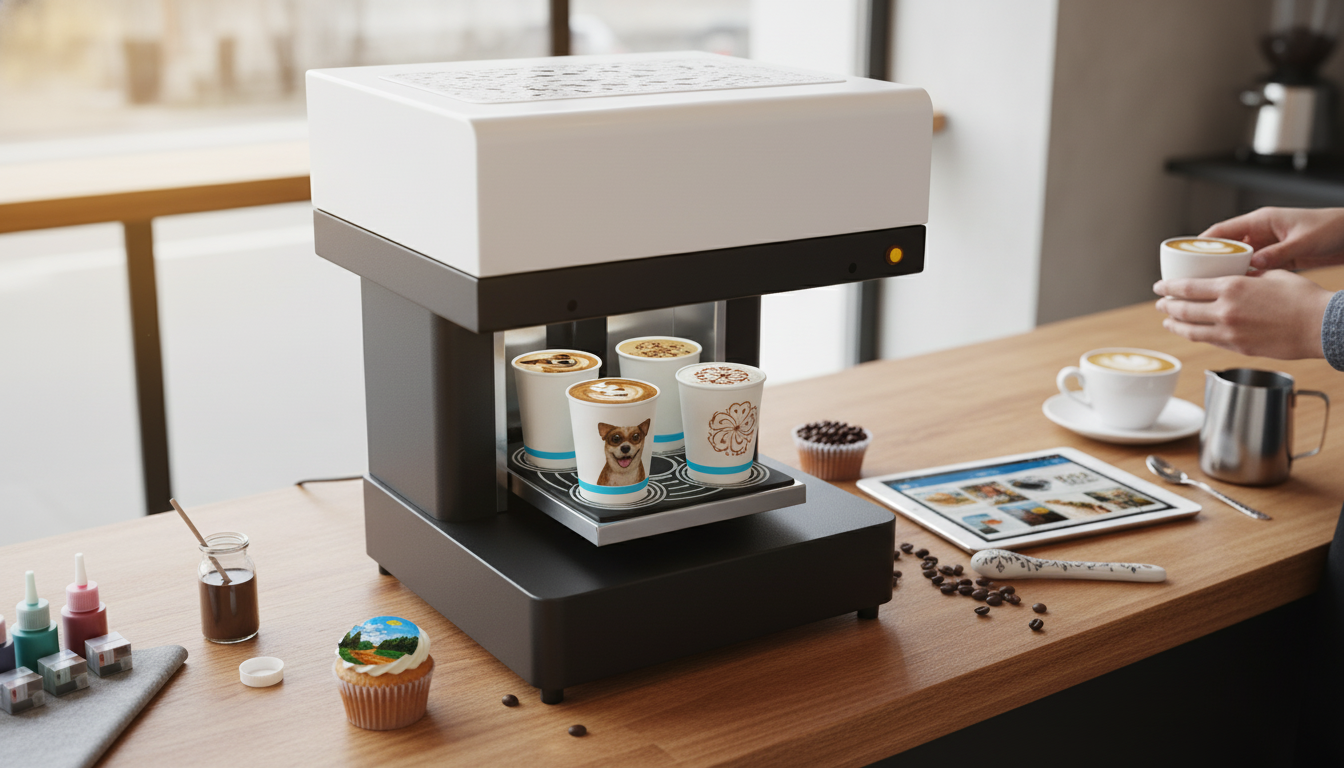
Multi-Cup Edible Art Printing for Photo Lattes and Decorated Desserts
Edible printing for drinks and desserts turns everyday service into a memorable, personalized experience. A multi-cup edible art coffee and cake printer is designed to place photos, logos, and themed designs onto latte foam, cakes, cookies, and other treats—helping cafés, caterers, and home creators deliver consistent, repeatable decoration with minimal manual piping skills.
What a Multi-Cup Edible Art Printer Does
A multi-cup edible art printer applies food-safe designs onto beverage foam and selected dessert surfaces with controlled, repeatable placement. Instead of relying on hand-drawn cocoa art or time-consuming icing work, designs are printed from a digital file, which helps standardize results across staff and shifts.
- Prints edible designs directly onto beverage foam and dessert surfaces using food-safe inks and printable media.
- Supports photo-style images, QR codes, logos, seasonal graphics, and custom text for events and branding.
- Multi-cup workflow focuses on serving more than one drink or item efficiently, reducing per-order decoration time.
- Typically pairs with an app or software for uploading images, editing layouts, and controlling print placement.
Best Uses: Cafés, Bakeries, Events, and Home Kitchens
Edible printing can be a practical production tool as much as a “wow” feature. The biggest advantage is speed with consistency—especially during rush periods or high-volume event service.
- Café menu upgrades: signature lattes, promotions, and limited-time art without relying on advanced barista free-pour skills.
- Bakery finishing: quick surface decoration for cakes, cupcakes, macarons, cookies, and chocolate panels (depending on the printable medium).
- Events and catering: weddings, birthdays, corporate events, and trade shows where personalized designs add perceived value.
- Giftable desserts: short runs of custom treats for holidays, sports teams, graduations, and fan art themes.
How It Works in Practice
Most workflows follow the same rhythm: prepare the design, prep the surface, print, then serve or package. Quality is determined as much by surface prep as it is by the printer itself.
- Design step: select an image or template, adjust contrast and crop for the target surface size.
- Surface prep: foam should be fine-bubbled and stable; dessert surfaces should be smooth, dry, and level for best clarity.
- Print step: align the cup or dessert tray; the printer applies edible ink in a controlled pass to form the image.
- Finishing: serve immediately for drinks; for desserts, allow ink to set based on the medium and storage conditions.
Common Printable Targets and Prep Tips
| Target | What helps the print look sharp | Common issues to avoid |
|---|---|---|
| Latte/cappuccino foam | Dense microfoam; level cup; minimal vibration | Large bubbles; watery foam; moving the cup mid-print |
| Iced drink foam/cream cap | Stable topping layer; colder surfaces can help set | Condensation; uneven topping thickness |
| Fondant/icing sheet on cake | Smooth, dry surface; room-temp handling | Sticky condensation; textured frosting without a topper |
| Cookies/chocolate panels | Flat surface; controlled humidity | Greasy surface; warm chocolate softening |
Edible Inks and Safety Basics
Because designs are consumed, ingredient handling and equipment hygiene matter as much as visual results. Choose consumables intended for edible printing and follow the manufacturer’s storage and handling rules to protect print quality and food safety.
- Use inks and consumables labeled food-grade and compliant with local food-contact regulations. For U.S. operators, review guidance from the U.S. Food & Drug Administration (FDA).
- Follow storage guidance for inks (temperature, light exposure, and shelf life) to prevent clogs and color shifts.
- Prevent cross-contamination: keep the printing area away from raw ingredients, splashing sinks, and aerosol cleaners.
- Confirm allergen statements when using edible papers, frosting sheets, or toppings that act as print surfaces. If you operate internationally or need a strong allergen-reference starting point, consult UK Food Standards Agency (FSA) allergen guidance.
For commercial environments, it can also help to understand third-party equipment expectations and sanitation-oriented design principles referenced by organizations like NSF.
How to Choose the Right Edible Art Printer
Not every edible printer is built for the same surfaces or service speed. Before comparing specs, decide what you’ll print most often and what “good” looks like for your operation (photo realism, readable logos, or fast output).
- Output use case: drinks-only vs. mixed desserts (some setups are optimized for foam while others excel with edible sheets or flat surfaces).
- Capacity and workflow: multi-cup handling, speed per print, and how designs are queued during rush periods.
- Resolution and color consistency: look for crisp edges on text/logos and predictable skin tones for photo prints.
- Supported media: direct foam printing, edible ink on frosting sheets, wafer paper, or other edible substrates (confirm compatibility before buying).
- Software/app reliability: template library, import formats, layout tools, language support, and offline/online requirements.
- Footprint and placement: counter space, ventilation needs, and whether the unit is portable for events.
- Maintenance expectations: nozzle cleaning routine, automated cleaning cycles, clog resistance, and availability of replacement parts/consumables.
Setup Checklist for Consistent Results
Cleaning and Maintenance Routines
Cost Drivers and Planning for Consumables
FAQ
Can photo-quality images be printed on latte foam?
Yes, but clarity depends heavily on stable microfoam, solid image contrast, and the printer’s resolution. For the sharpest results, use simple backgrounds, avoid tiny text, and test with one standard cup size so you can reuse proven settings.
What surfaces work best for edible printing on desserts?
Smooth, dry, level surfaces produce the cleanest edges—such as fondant, frosting sheets, and flat chocolate panels. Textured buttercream or wet/condensing surfaces usually soften detail unless you apply an edible topper designed for printing.
How often does an edible art printer need cleaning?
Plan on daily wipe-downs of contact areas and periodic nozzle checks, with a deeper weekly cleaning per the manufacturer’s instructions. Heavy daily volume or long idle periods typically require more frequent maintenance to prevent clogs and color dropouts.










Leave a comment