

Real Estate Investing in College: House Hacking Basics

Real estate investing in college: why an early start can actually make sense
Real estate is one of the few wealth-building paths where time and repetition can matter more than a huge starting bankroll. For college students, the most realistic first step is often a live-in purchase that lowers housing costs while teaching the fundamentals in real time. When the property doubles as your home and your “first deal,” you can build skills—budgeting, negotiation, tenant screening, and maintenance—without needing to scale fast.
Why starting during college can work
College years can be a surprisingly practical window to learn real estate—especially if your goal is to reduce housing costs rather than chase a perfect investment on day one.
- Housing is usually the biggest monthly expense. If roommates help cover part of the payment, you can redirect money toward savings and future down payments.
- Your first property becomes hands-on education. You’ll learn how to compare neighborhoods, read inspection reports, set rules, and manage shared bills.
- Early mistakes are often smaller. It’s better to learn on one property with a simple roommate setup than on multiple units with thin margins.
- Post-grad flexibility helps. After graduation, you may relocate—making it easier to convert a live-in property to a rental, refinance, or sell based on your next move.
Key concepts to understand before looking at properties
Before you tour anything, get clear on the numbers and the risk. The goal is to avoid “guesswork math” that only works when everything goes perfectly.
- Cash flow basics: roommate or rent income minus mortgage, taxes, insurance, utilities, repairs, and vacancies.
- Total monthly cost mindset: don’t stop at the mortgage payment; include everything you’ll actually pay.
- Reserves: a realistic starter buffer is often a few months of housing expenses plus a repair fund.
- Leverage and risk: financing can speed up progress, but only if you can survive vacancy, a job change, or an internship gap.
- Exit plans: decide what “good enough” looks like—sell, keep as a rental, or refinance—before you buy.
For a practical overview of the buying process and common pitfalls, the Consumer Financial Protection Bureau’s homebuying hub is a helpful reference: Consumer Financial Protection Bureau — Buying a House.
House hacking strategies that fit student life
House hacking is simply using your living situation to reduce (or potentially eliminate) your housing payment. For students, the simplest version is usually the best: predictable, easy to manage, and not dependent on perfect tenants.
Common house hacking setups
Quick comparison: student-friendly ways to get started
| Approach | Upfront complexity | Typical benefit | Common risk to plan for |
|---|---|---|---|
| Rent spare bedrooms | Low–Medium | Cuts monthly housing cost | Roommate mismatch; uneven bill sharing |
| Live in a duplex/triplex | Medium | Stronger offset with separate units | Higher purchase price; landlord responsibilities |
| Mid-term rental room/unit | Medium | Often steadier than nightly stays | Turnover; furnishing costs |
| Buy now, rent later after graduation | Medium | Turns first home into first rental | Relocation timing; vacancy during move |
Financing options and what lenders usually care about
- Credit and income: clean payment history and reasonable debt-to-income often matter more than a “perfect” score.
- Co-borrowers and cosigners: can help you qualify, but clarify who pays what, and confirm how title/ownership is structured.
- Low down payment programs: many require owner-occupancy—review eligibility and rules for your situation. FHA details are here: U.S. Department of Housing and Urban Development — FHA Loan Program.
- Upfront costs beyond down payment: closing costs, inspections, moving, immediate repairs, and initial furnishings.
- Paperwork readiness: organize pay stubs, tax returns, bank statements, and explanations for large deposits before you apply.
How to analyze a deal fast (without skipping the essentials)
Running the property while keeping school first
Mistakes that derail first-time student investors
If you plan to convert your place to a rental later, it’s also worth understanding the tax basics early. A solid starting point is: IRS — Publication 527 (Residential Rental Property).
A practical digital guide for first steps and house hacking
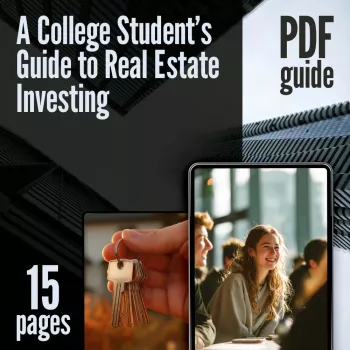
- To stay organized from lender conversations through roommate screening, consider A College Student’s Guide to Real Estate Investing (Digital PDF).
- For simple move-in organization that helps reduce “where did the keys/lease papers go?” stress, an at-home storage piece like the Modern Glass Storage Jar with Golden Butterfly – Elegant Home Decor can be a tidy catch-all for small essentials.
- For long days of tours, errands, and maintenance runs, a comfortable layer such as the Women’s Abstract Print Loose Hoodie can be an easy grab-and-go option.
A simple next-30-days action plan
FAQ
Can a college student buy a property with little savings?
Yes, but “little” still needs to cover more than the down payment: plan for closing costs, moving costs, and a reserve buffer for vacancies and repairs. Some students qualify with steady income, a co-borrower, or owner-occupied loan programs, but the safest approach is choosing a payment that still works if roommate income drops.
Is house hacking worth it if roommates are unreliable?
It can be, if you screen consistently, put expectations in writing, and budget conservatively for vacancy. Layout matters too—setups with better privacy and separate entrances tend to reduce friction and make roommate turnover easier to handle.
What should be included in a basic deal analysis for a first property?
Include taxes, insurance, HOA (if any), utilities, internet, repairs/maintenance, and a vacancy allowance—then test stressful scenarios like a roommate leaving or a major appliance failing. If the deal only works under best-case assumptions, it’s not a stable first buy.













Leave a comment